A/B Testing & Experimentation
Everyone has a theory about the homepage
Every team has theories about what would convert better. A shorter form, a different headline, proof higher up the page. The theories are usually held with confidence, argued in meetings, and never tested, so the loudest one wins.
We help teams test them properly instead, against real visitors, and keep whatever actually moves a number. That includes our own theories, which turn out wrong as often as anyone's.
What is A/B testing for a website?
A/B testing shows two versions of a page to different visitors and measures which one does its job better. Experimentation is the wider discipline around it: forming a hypothesis about why people drop off, testing it against real behaviour, and acting on the result. It lets a site improve on evidence rather than on whoever argued best.
How we work
Every test starts as a hypothesis tied to something we've seen in the data, not a hunch about what might look better. We run it in PostHog on the live site, for long enough for the result to mean something, then ship the winner and write down what the loser taught us. On lower-traffic sites we test bigger changes less often, because pretending a small test is significant helps nobody.
Case study: Forest: Common Sense Club quiz
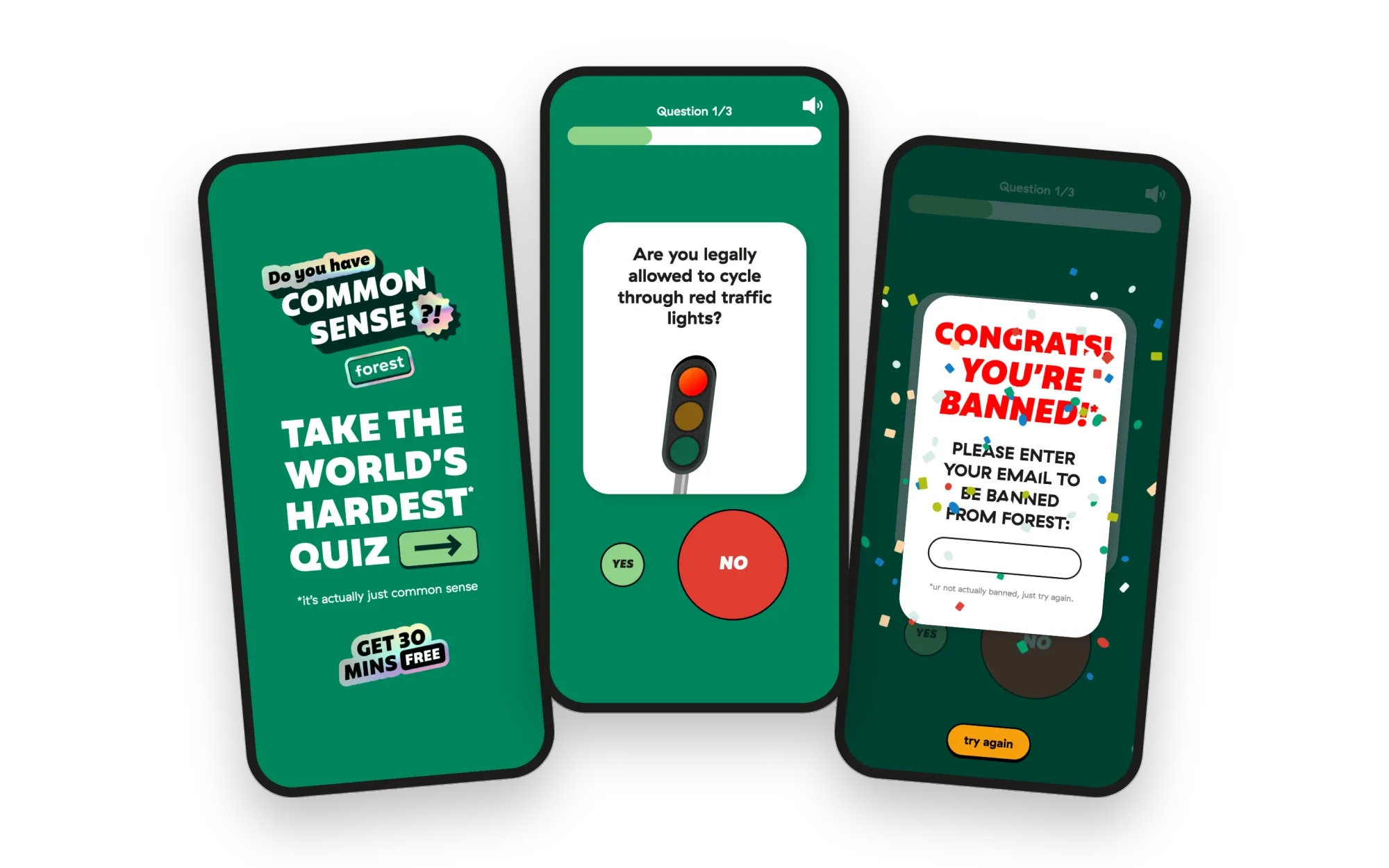
Forest's safety quiz was an experiment in what an audience would actually finish. A 15-question quiz with conditional branching and per-answer feedback, tracked through HubSpot and GTM, held 81.6% of players to the end.

- Quiz starts
- 5,000+
- Completion rate
- 81.6%
What's included
A/B testing is part of the Optimisation retainer, from £5,000 a month. It covers an experiment backlog built from your data, PostHog experiment setup and feature flags in Webflow, test design and run-time planning, implementation of the winners, and a running log of results your team can read.
Outcomes
Changes stick because they were proven rather than argued, and over time the test log becomes a record of what your buyers actually respond to, which is worth more than any single result. The site keeps improving without the periodic redesign driven by whoever spoke last.